
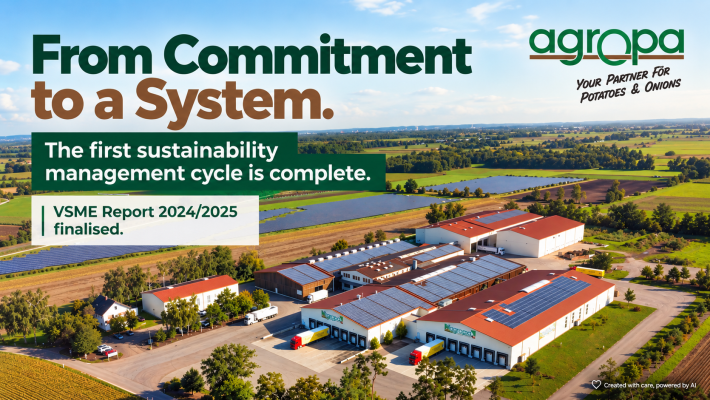
At Agropa Handels GmbH, we have reached an important milestone: the VSME Report for the 2024/2025 financial year has been completed. But this does not simply mark the end of a reporting project. Rather, we have completed a first full cycle of systematic sustainability management.
It all started around a year ago with the ZNU Sustainability Check. Together, we assessed where Agropa stood and identified the areas we wanted to develop systematically. From there, we proceeded step by step:
- raised awareness of sustainability among employees and provided training
- adopted a Sustainability Statement and Code of Conduct
- prepared and reviewed the first Scope 1 and Scope 2 carbon footprint
- analysed stakeholders and the value chain
- conducted a comprehensive double materiality assessment
- used the results to identify the key sustainability topics and derive specific targets and measures
- established sustainability controlling based on the relevant KPIs
- and finally prepared the VSME Report using leadity, with texts and content consistently tailored to Agropa.
Building the KPI system in particular highlighted one of the biggest challenges facing mid-sized companies: Sustainability management needs its own “accounting system”. Data needs to be clearly defined, collected, documented in a traceable manner and made comparable over time.
One aspect was particularly important to me – more important than developing as many sophisticated concepts as possible: Agropa’s management and sustainability manager were continuously involved throughout the entire process. They assessed the issues, set priorities and determined the content. Because sustainability management can only work in the long term if it belongs to the company – not to the consultant.
I increasingly see my own role as that of a navigator: interpreting requirements, showing a practical way forward, providing methods and tools, and ensuring that numerous individual requirements come together to form a functioning management system.
What comes next?
The next cycle begins in October. With the 2025/2026 financial year, we will have comparative data for the first time – making KPIs, targets and measures increasingly useful as management tools. Agropa will also take the next steps in climate management. The carbon footprint is to be expanded to include relevant Scope 3 categories. This will be accompanied by registration with the SBTi and the calculation of FLAG emissions. Our aim is to establish the basis for a credible decarbonisation pathway and achievable, science-based climate targets. Within a year, the initial assessment has thus evolved into a systematic process.