
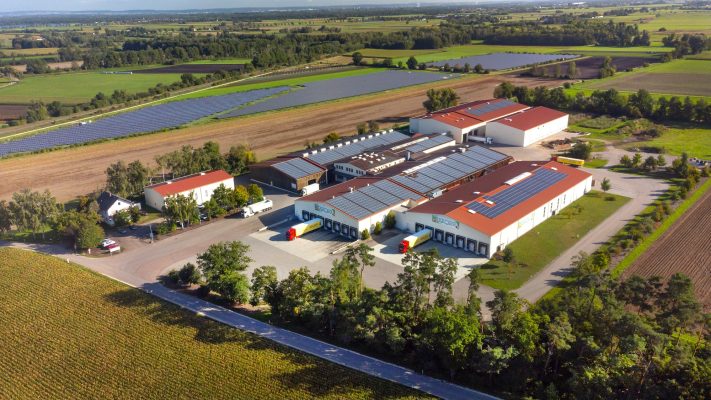
Sustainable business practices are often described as complex. The real challenge lies elsewhere: turning this complexity into clear priorities. This is exactly what Agropa Handels GmbH (see aerial view of the central site in Brunnen/Bavaria) has consistently achieved in recent weeks. The double materiality analysis has been completed – providing a clear, decision-relevant overall picture.
Structure that enables thinking – not replaces it
The process was deliberately designed in a pragmatic way together with Manuela Hierl and Johann Dittenhauser Jr. The central foundation was the use of the leadity software, complemented by the potato industry solution as a structured template within the system. The key advantage: the industry solution served as a structured source of ideas – not as a predefined answer. It helped to make typical topics along the value chain visible, to address relevant questions at an early stage, and to keep the discussion focused on substance. Without this structure, a different pattern often emerges in practice: discussions tend to revolve around Excel logic and wording instead of actual priorities. Using leadity as a working basis, the team was able to concentrate on what is truly relevant for Agropa.
From industry perspective to company-specific clarity
On this basis, the content was further developed in a consistent way – moving from general assumptions to a clear, company-specific assessment. The process followed three steps:
- Stakeholder analysis
- Impact screening along the value chain
- Risk and opportunity assessment
The result is a robust basis for decision-making – not only for reporting, but for managing the business. A particular strength of the chosen approach lies in its methodology: leadity is built on the ZNU standard and consolidates the results in a three-dimensional materiality matrix. This means combining:
- an inside-out perspective (impacts on environment and society),
- an outside-in perspective (financial risks and opportunities),
- and stakeholder relevance (weighting by stakeholders),
to create a complete picture. And, above all, a prioritization that is both technically sound and aligned with business decision-making. The topics in the upper right quadrant of the matrix are the material ones.
A clear picture: impact vs. controllability
The results reveal a typical but decisive pattern: the most significant sustainability impacts arise in the upstream and downstream value chain – particularly in agriculture, packaging, and international supply relationships.
At the same time, the direct levers for action lie within the company itself, especially in the areas of energy and climate protection, organization and processes, and the design of partnerships. From a wide range of possible topics, a clearly prioritized set has been derived. At the core for Agropa are:
- Climate protection and energy efficiency
- Packaging and resource use
- Sustainable sourcing and fair collaboration
- Demographics and fair wages
This provides the essential basis for focusing on what matters most.
The next step: implementation and VSME+
With the analysis completed, the direction is clear – the next step is implementation. At Agropa, this includes:
- Developing a concrete action plan
- Integrating sustainability into existing processes and responsibilities
- Establishing a system of key performance indicators
This will be followed by structured sustainability reporting based on VSME+. Internal clarity thus becomes external alignment – towards customers, banks, and other stakeholders.
Collaboration that creates impact
The success of the process was not only due to the methodology, but also to the collaboration: Manuela Hierl contributed the necessary structure and depth, while Johann Dittenhauser Jr. brought entrepreneurial clarity. As it was aptly summarized during the project:
“We now have a shared understanding of what really matters – and can work on it in a focused way.”
My role was to design the process in a way that remains manageable for the company. The focus was on providing structure without overloading it, keeping discussions focused, and consistently aiming for practical implementation – as a partner at eye level.
Conclusion
Double materiality is often perceived as a regulatory requirement. In practice, it proves to be a strategic management tool when applied in a structured and pragmatic way. Agropa has used this approach consistently, gained new insights, and established a solid foundation for further developing its sustainable business practices.